

Nowadays, corporations have realized that impressive resumes and skills of an employee are not the only criteria for successful hiring decisions and sustainable employee engagement. Therefore, they rely on understanding whether a person’s inner wiring matches the environment they’re stepping into.
For this, most organizations hunt for psychometric tools such as culture-fit tests and Values & attitude assessments, which can give them a clear picture of whether a candidate will align, adapt, and thrive within the company culture. However, the challenge lies in understanding the subtle distinction between a culture-fit test and a values & attitude measuring tool so that leaders can decide not just who fits in, but who will truly thrive.
What Is a Culture-Fit Test? - (Measuring harmony between personal traits and company culture)
A culture-fit assessment is a psychological tool designed to evaluate an individual’s fundamental beliefs, behavioral patterns, and work-related dispositions to determine whether they align with the expectations of a particular role and the broader cultural environment of the organization.
Rather than labelling someone as ‘good’ or ‘bad,’ the purpose of a culture-fit test is to highlight the degree of alignment, harmony, and mutual suitability between a potential or existing employee and the company’s work culture.
What Are Values & Attitude Assessments? - (Measuring the personal principles and core mindset that determine workplace behavior)
Values & attitude assessments help uncover what truly drives a person at work — their beliefs, mindset, and natural reactions. Instead of judging skills alone, these tools focus on the human side of performance: the values people stand by and the behaviours shaped by those values.
They show how well someone’s inner compass aligns with the company’s culture, helping employers understand if they’ll collaborate well, handle challenges maturely, and contribute positively. It’s never about “right” or “wrong,” but about understanding what makes someone tick. When people’s mindsets match their workplace, they feel understood, supported, and set up to succeed — and that’s when teams thrive.
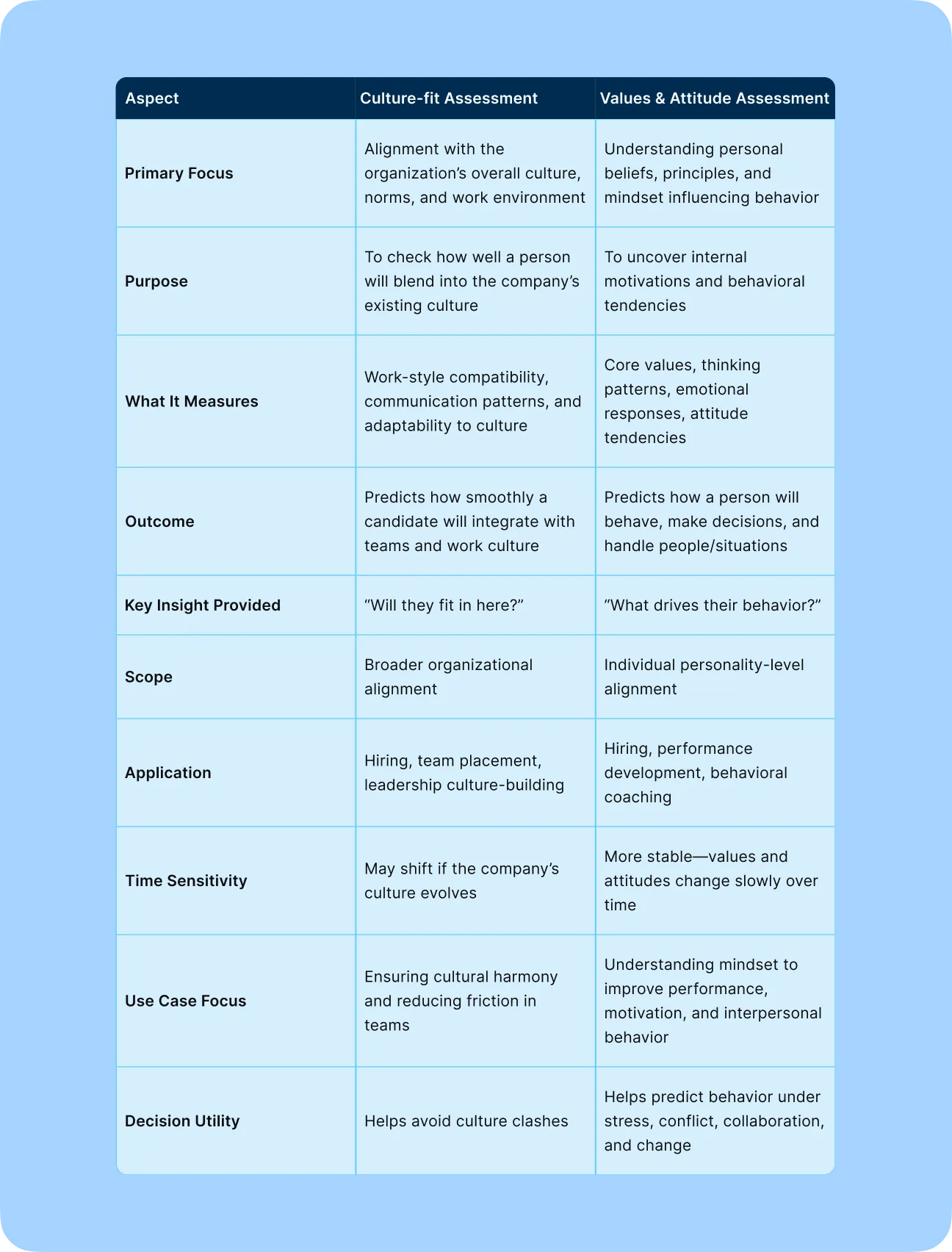
Why Do Many Organizations Confuse the Two?
Many organizations mix up culture-fit tools with values–attitude tools simply because both seem to talk about “how people show up at work.” At first glance, they look alike, and in the rush of hiring and managing teams, that subtle difference gets missed. Culture-fit tools focus on the external environment, whether someone can blend into the company’s way of working. Values–attitude tools go deeper, revealing the beliefs and mindset that shape a person’s behaviour.
When decisions need to be made fast, it’s easy to assume that visible behaviour tells the whole story. However, in reality, external alignment to a specific culture type often comes from deeper personal values. That overlap creates confusion, even though each tool answers a very different question.
Real-Life Workplace Examples Where the Distinction Matters
→ The “Perfectly Polite but Poor Fit” Candidate
A candidate is friendly, communicates well, and behaves professionally — so the team assumes she’s a great cultural fit. However, later, they realize that her core values prioritize individual achievement over collaboration, causing friction in a teamwork-oriented environment.
What went wrong: The person seemed perfect on the outside — polite, professional, and easy to work with. But once the real work started, it became clear that what they truly believed in wasn’t the same as what the team valued. Their decisions, priorities, and way of working didn’t line up with how the team operated. So even though their behaviour looked right at first, the deeper values behind those actions didn’t match what the team needed.
→ The Fast Hire Who Looked Right but Didn’t Last
A growing startup brings in a new teammate who instantly clicks with everyone — he’s energetic, easygoing, and blends perfectly into the lively office vibe. At first glance, he appears to be the ideal cultural fit. But once the real pressure kicks in, a different side shows up. His personal values lean toward taking shortcuts, finding the quickest fix, and doing “whatever gets the job done,” even if it means bending rules and not following the company policies. This clashes with the startup’s core belief in transparency, honesty, and doing things the right way, even when it’s slower.
What went wrong: What started as a smooth cultural match quickly turned into friction. The mismatch in values created trust issues, forced the team to constantly double-check his decisions, and eventually affected team morale. In the long run, the company realized that a lively personality can’t replace strong, aligned values.
Concluding Remarks: Integrating Both Tools in Modern HR Decisions
Nowadays, organizations are increasingly realizing that it’s not enough to look at culture-fit alone. They want to understand a person’s values and attitudes alongside how well they blend into the work environment. When these two insights come together, companies gain a clearer, more holistic view of who the individual truly is — how they think, what they stand for, and how comfortably they’ll thrive within the team. This combined approach helps organizations hire people who not only fit in on day one but also grow with the company in the long term, creating stronger, more aligned workplaces.

Related posts
Lorem ipsum dolor sit amet, consectetur adipiscing elit.